
Long-form interview & upcoming events
SD Zine Fest, Fairfax & Benicia readings

Upcoming Events:

I’ll be tabling all of the Recenter Press books at San Diego Zine Fest this year! On Sunday, October 19th ONLY, catch me from 12pm-6pm at WOO! Studios (2212 Main St., San Diego, CA) for a day-long celebration of indie / DIY publishing in one of my absolute favorite cities. There are so many incredible vendors this year, so if you’re in the Southern California area, you don’t wanna miss it.
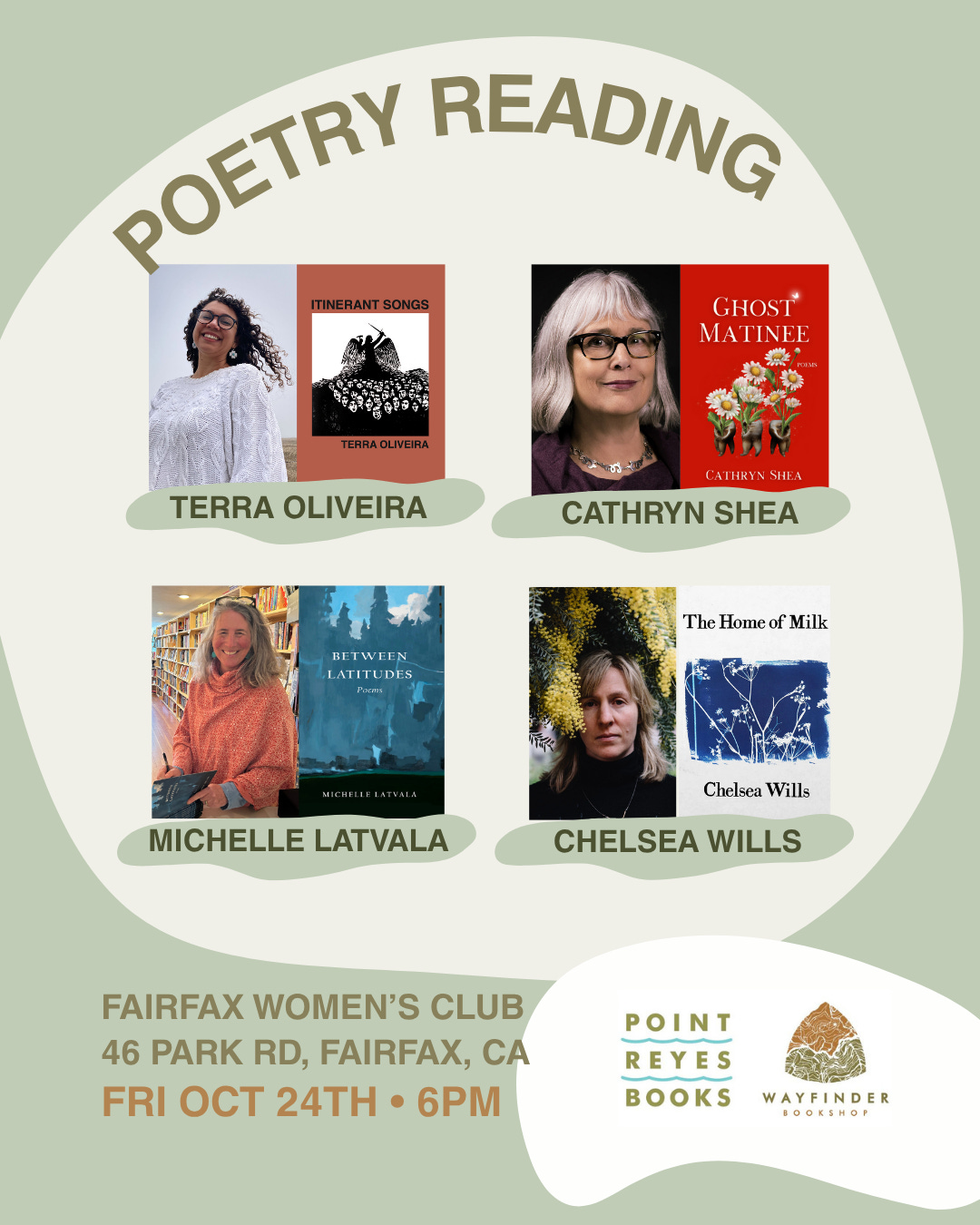
On Friday, October 24th at 6pm, join us at the Fairfax Women's Club (all genders welcome 😉) in Fairfax, CA for a celebratory evening of poetry hosted by the loveliest Point Reyes Books. We'll hear from established local authors reading from their latest: Michelle Latvala's Between Latitudes, Cathryn Shea's Ghost Matinee, Chelsea Wills’ The Home of Milk, and I’ll be reading from Itinerant Songs.
Michelle Latvala is the author of Between Latitudes, published by Green Writers Press 2025. She is faculty for poet David Whyte’s Institute for Conversational Leadership, served as Executive Director of Spirit Rock Meditation Center for a decade, and founded a series of nature-based writing and meditation programs called Insight Outside. Michelle migrates thoughtfully between responsibilities in northern California and eastern Alaska, where she built a cabin at the same latitude her Finnish ancestors inhabited for centuries in the shared circumpolar boreal forest.
Cathryn Shea's second full-length poetry collection is Ghost Matinee (April 2025). Her first is Genealogy Lesson for the Laity (both with Unsolicited Press of Portland, Oregon). A Best of the Net nominee, Cathryn's poetry has been widely anthologized and has appeared in Rust + Moth, Poet Lore, Quiddity, Gargoyle, and extensively elsewhere. Cathryn is a fourth-generation northern Californian living with her family in Fairfax, CA.
Chelsea Wills is a writer, interdisciplinary artist, and clinical herbalist based in Northern California. Her published works include Home of Milk (Bottlecap Press, 2024), Love Letters from the Moon (2017), and Teach Me How To (Works Progress Agency, 2020). With a Master’s degree from UC Berkeley, she has shown work and taught locally and internationally. Her writing weaves the eroticism of parenting, place-based knowledge, and community healing, centering memory, imagination, and reverent curiosity at the intersection of what it is be a person becoming.
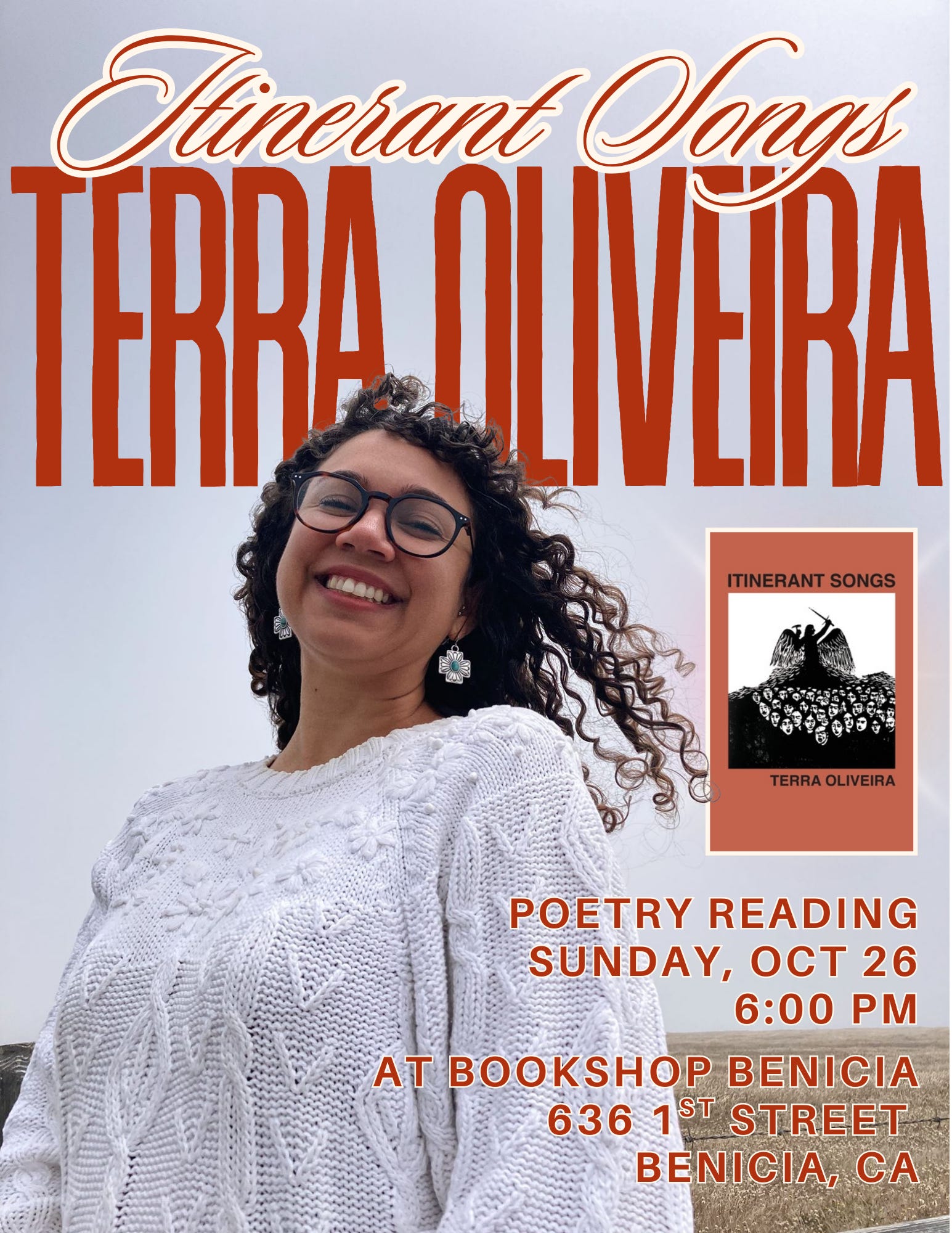
On Sunday, October 26th at 6pm, join me for a poetry reading and book signing of Itinerant Songs at the wonderful Bookshop Benicia in downtown Benicia. I’m looking forward to another hometown reading, and so thankful for how supportive the Solano County poetry community has been for my work. See you there!
Full interview with Benicia Magazine:
The following is the complete interview between Editor-in-Chief of Benicia Magazine, Cooper Mickelson, and me which took place in August for this article in the Fall 2025 issue of Benicia Magazine.
Cooper Mickelson: As someone who has grown up in Benicia, how has this place shaped your voice as a writer and the themes you explore?
Terra Oliveira: My relationship to Benicia, and writing about where I’m from, has shifted a lot over the last few years. In one of my first poetry books, An Old Blue Light, I wrote from a place of restlessness and wanting to leave home. Some lines from poems in An Old Blue Light: “i am leaving California. / i do not wish to be so small” and “i’ve got to keep moving / so the flies do not get me” come to mind. Growing up, I remember feeling out of place, limited, and trapped, and the confluence of those feelings with some hardships and a strong traveling itch led me to leave, and to write about that leaving.
On the other hand, my new poetry book, Itinerant Songs, is split into three parts: “On Work,” “On Country,” and “On Going Home.” The book begins in settings throughout Philadelphia, where I lived and worked from 2017-2023. “On Going Home” is influenced by years of transience and ultimately wanting to live closer to my family, to explore writing about my relationships to them through dreams, loss, and grief.
My grandmother, Teruko Azevedo, lived in Benicia for over 50 years. She suffered from dementia during the last years of her life, and my desire to be closer to her both influenced my decision to move back to the Bay Area and inspired a number of poems in the section “On Going Home.” The need to hold on to precious, limited time with family comes through a lot in the later poems of Itinerant Songs and in my pull to live in or near Benicia. Home is wherever my family is, and my family has lived in Benicia for three generations. “On Going Home” also means coming home to myself and to God, too, and is meant to convey that home is not only a physical space, but a spiritual dwelling.
Cooper: How does being from a small waterfront town inform the way you approach broader, more global themes in your work?
Terra: Water, and the ways it's been polluted and owned instead of protected and held in common, is a recurring theme in Itinerant Songs. Sitting near water has been an important ritual for me since I was a small child, when my mom would take my sister and I to sit at the waterfront near Semple Court and West G Street in Benicia. The ritual continued into high school, sitting on the benches on West K Street during off-campus lunch breaks, looking out at the water and getting stoned with my then-high school boyfriend. Then in college, when I went to San Francisco State University, I lived near Ocean Beach and would walk for hours along the shore with friends or in quiet contemplation. Then there is my heritage: coming from waterfront lineages in Hawai’i, the Azores, from peoples who rely on water quality (which we all do) and food from the sea. Observing the water, writing about its sanctity, and talking about the ways it's been disrupted by capital from Hawai’i to the Delaware River is a central theme in Itinerant Songs.
Cooper: Your lineage spans the Hawaiian Islands, the Azores, Southern China, Guadalajara, and Europe; how does that rich cultural heritage shape your storytelling?
Terra: Learning about my lineages has been central to my writing practice and exploration of my own personhood. My mom was adopted when she was an infant, and I did not know any of my dad’s father’s extended family, so I was raised knowing very little about our cultural heritage(s) and family bloodlines. I also had a hard time with strangers’ incessant questions about my ethnic background growing up, and not knowing how to answer them.
In 2020, I started thoroughly tracing our ancestry, connecting with my mom’s biological family, and learning more about the regions our lineages were from. One of the poems in Itinerant Songs, “Nā Kahawai (The Rivers) of My Great Grandmother, Maude,” traces my family’s ancestry as if they were the merging of many rivers, and the grief of estrangement and disconnection from homeland. I wrote several poems about Hawai’i as a means to reconnect with that heritage and to reclaim it. I also wrote a handful of poems in Itinerant Songs while I walked the Caminho Português, the Portuguese Way of St. James, which I walked with the goal of learning more about my Portuguese ancestry.
As integral as connecting with ancestry and lineage has been to my creative practice and understanding of my background, I relate more to the phrase that goes something like “the blood of battle is thicker than the water of the womb.” Meaning, the bonds with my grandmother, “Bachan,” who raised my mom, or with my stepdad, who lost his life in a power plant accident last year, are as much a part of my life-heritage and life-story as any bloodline could possibly be.
Cooper: How do you navigate holding so many intersecting histories and identities in your work?
Terra: I think because my identities have been a process of exploration and discovery more than a single inheritance or a fixed upbringing, my writing ends up being an extension of that exploration, too. My identities at times have felt disjointed and fragmented, making it difficult to understand their intersections. Then, they do begin to make more sense and feel more cohesive when studying migrations and histories, such as the Chinese and Portuguese’ labor migrations to Hawai’i for instance. My writing might feel disjointed to some readers as I don’t write about any one specific place—reading Itinerant Songs, you will find Philadelphia, the Bay Area, Hawai’i, China, and Portugal, and a good deal of movement. That sense of holding so many places at once both as home and as identity is something I’ve needed to navigate and contend with my whole life, there is no one single homeland, so that is something my readers will need to hold too as I write from place to place.
Cooper: You’ve described recovery as one of your core practices. How has that journey influenced the stories you tell and the way you tell them?
Terra: I’ve been sober since my mid-twenties, and involved in a number of twelve step programs since my late-twenties. While I did write poems and personal essays prior to starting my recovery journey, the twelve step framework has drastically changed the way I write. I used to write a lot more diaristically, which is now more reserved for my private journal and for processing with my recovery communities and in my personal relationships. I don’t think I “expose” myself through my public writing as much as I once did, and I process trauma in much different ways. People who read my writing are getting a more processed, thought-through, and polished version of my experiences and my ideas, which is definitely healthier for me personally. Also, the twelve step framework, and other spiritual practices I’ve been involved in, greatly shape the perspective from which I write. I write about faith and the twelve step concept of “turning it over” quite a bit in my poems, and my writing has become more grounded and less fantasy-oriented.
Cooper: What role has writing played in your healing process?
Terra: Writing helps reveal what is dormant or hidden within us. When I write, my thoughts and feelings become more conscious and obvious to me. I may write the same thing over and over again to myself — that I am uncertain about a relationship or a job, that I want to reach a specific goal or achievement in my life — in a way we can’t deny to ourselves. Writing in any form brings me closer to myself.
Writing poetry has also been healing for me because the practice communicates to me that my interests and passions are worth pursuing, that my craft matters regardless of how much time it takes and how little material gain it brings me. I think my poetry also reminds me of my spiritual values, which can be easy to lose touch with in moments of doubt, anxiety, and fear. My poems are often more spiritually grounded than the states I might find myself in, mostly because of the place within me that my poetry is coming from. Sometimes I’ll read my poems and think, “Wow, thanks, I forgot and really needed that.”
Cooper: What would you say to someone who wants to use creativity as part of their recovery journey?
Terra: Recovery has given me the time and the tools to focus on my creative ambitions. I’m less distracted by self-destructive pursuits and more trusting of the process that I’m exactly where I need to be. Recovery also helps me handle rejections (from literary opportunities, people, etc) with more grace, helping me to remember that rejection is protection from the things that aren’t meant for me.
Creativity is such a huge part of my recovery, and it doesn’t only need to be about mastering a craft or professionalism either. It can be about play, self-expression, and discovery that doesn’t always need to be witnessed, about letting ourselves express and bring shape to what is alive within us in any form. For example, creativity through dance has been a very healing part of my recovery journey, both through improvised dance as a form of somatic therapy and also choreographed Polynesian dance. Those practices aren’t something I share publicly very often, and they help me take myself less seriously and find more play and meaning in my day-to-day. Creativity is a spirit we can bring to almost any act.
Cooper: Your work connects to pilgrimage, retreat, and peoples’ movements globally. How do those practices and experiences feed your creative life?
Terra: Some of my best writing and shifts in life-direction have come during or immediately following retreats. My poem, On the Way of St. James, is one of my favorite poems in Itinerant Songs, and it was written during a three-day monastic retreat while I was walking the Caminho Português. Retreating from a day job and from technology especially help ground me more in my center and in my higher power, and it is from this place that my best writing often comes from. On retreat, the writing feels more like a channeling experience than something coming only from “me.”
Regarding peoples’ movements, I am lucky to have received a good deal of mentorship about the histories of labor movements, anti-war movements, and anti-imperialist movements through political organizations I have been a part of. My writing is rooted in the belief that housing, water, food, healthcare, and freedom from war and oppression are fundamental human rights that must be ever-strived towards.
Cooper: How do you hope your work contributes to building or sustaining community, here in Benicia, and beyond?
Terra: While writing is often a solitary act, poetry cannot live in isolation — we depend on each other to share and uplift each other’s work. My hope is to continue participating in and organizing poetry readings around the Bay Area, to connect with other writers and promote each other’s work, and to continue publishing poetry and art through Recenter Press with an emphasis on local writers.
Cooper: Can you share a moment when your writing intersected with activism or collective action in a meaningful way?
Terra: A number of my poems in Itinerant Songs were written when I was a community organizer with the Philadelphia Liberation Center — such as my poem, Philly Spring Cleanup, which was written about a neighborhood trash cleanup and our collaboration with neighborhood block captains. Tenants’ and workers’ rights are also a common theme, all inspired by my experience as a community organizer and involvement in anti-war struggles, workplace organizing, and political education programs.
Cooper: Recenter Press was founded in 2017 and has now come home to the Bay Area. What inspired you to start this publishing house?
Terra: I’ve been inspired by the DIY / independent publishing scene since the first time I attended the East Bay Alternative Book & Zine Fest (EBABZ) in 2014. Seeing how exciting and possible it was to self-publish and get our work out there, I told myself I wanted to publish enough books to fill up a table someday. I then learned how to self-publish poetry and photography books, including a feminist photo book I funded on Kickstarter in 2015. In 2016, I first tabled my own poetry and art books at EBABZ and Olympia Zine Fest. When I had a poetry book selected for publication with Where Are You Press (based in Portland, Oregon), I realized I had accumulated enough knowledge and skills about self-publishing to begin publishing others’ work. I also wanted to create a publishing house that paid authors fairly, uplifted marginalized voices, and emphasized the themes I was interested in.
As soon as I moved to Philadelphia, I created a website and social media accounts and launched Recenter Press. The hand-carved block print logo I made at the time is the logo I still use to this day. Initially, I began with publishing writers’ personal essays and author interviews, then put out a call for manuscript submissions. Since then, I’ve published five poetry books by authors from around the U.S. in addition to my own books, five issues of the Recenter Press Poetry Journal, and occasionally vended books across the country from punk rock flea markets to the AWP Community Bookfair. I’m tabling Recenter Press books at the San Diego Zine Fest on October 19th this year, and I really can’t wait for it.
Cooper: Recenter Press publishes work on themes like workers’ rights, racial justice, recovery, and our interdependence with the natural world. How do you choose the voices and stories you amplify?
Terra: I do a mix of outreach to authors and artists whose work I follow, and put out open calls for submissions. When curating my selections for publication, first and foremost I prioritize the strength of the work and the political perspective (if any) it is written from. I also pay close attention to ensuring I’m publishing a diversity of voices, and prioritizing people of color, LGBTQ people, and women. The following or notoriety someone does or doesn’t have is not a factor at all — I am happy to publish both established and emerging voices as long as there is merit, craft, and truth to the work. For each issue of the Recenter Press Poetry Journal, I select twenty poets and one artist to publish, so there have been many times where I’ve said no to truly excellent work that just didn’t fit a particular issue. My selection process is often personal and subjective.
Cooper: What are your hopes for Recenter Press now that it’s rooted back in the Bay Area?
Terra: I’d love to publish annual issues of the Recenter Press Poetry Journal, to continue to organize poetry readings throughout the Bay Area, and to keep tabling at book fairs around the West Coast. As of now, I can’t foresee when or if I will open manuscript submissions again, but I’m looking forward to continuing to use the Recenter Press platform to uplift progressive voices in whatever ways I can.
Cooper: Itinerant Songs has been described as “a yearning for home.” What does home mean to you in the context of this collection?
Terra: The “yearning for home” described in Itinerant Songs is the search and the struggle for housing security and affordability, for a living wage rewarded for meaningful work that can provide us with a dignified, resourced life. Especially in Itinerant Songs’ first section, “On Work,” my poems explore the difficulty in earning an adequate wage that can keep up with the cost of living, and the amount of times I’ve needed to move or change jobs in order to support myself. The “On Country” section of Itinerant Songs is the search for home as a part of a community and cultural identity, challenging the ways U.S. imperialism has stripped communities apart and torn people away from their lands. The third section, “On Going Home,” explores finding home along the spiritual path, looking at our family dynamics, and finding a piece of home within ourselves.
Cooper: The book speaks to both the political and the spiritual. How do you balance those two dimensions in your poetry and your life?
Terra: My spiritual beliefs and my political convictions go hand-in-hand, I wouldn’t be able to separate them. My spirituality informs my politics and my politics inform my spirituality. I look to leaders like Howard Thurman, Martin Luther King Jr., Archbishop Óscar Romero, Jesus, Mahatma Gandhi who united their spirituality with their politics, who treated union with God and service of people equally. I hope that in my writing and in my life-practice, politics and spirituality compliment rather than compete with each other.
Cooper: If there’s one feeling or understanding you hope readers carry with them after finishing Itinerant Songs, what would it be?
Terra: Hope for their own and our collective futures.
Cooper: What does your creative process look like? Do you approach writing as ritual, discipline, or something in between?
Terra: I have really struggled to maintain any kind of writing ritual or writing discipline. Sometimes I will go months without writing, hence Itinerant Songs taking me nearly eight years to write. I’ll usually write when I’m already thinking in poems, which comes from being more observant of my thoughts and my surroundings, and getting myself into the habit of writing down whatever’s coming up. I’m pretty out of the habit right now. Having just published a book that I’ve been working on for this long, I’m less inclined to want to create something new, but rather I’m excited to focus my energy on nurturing and sharing this completed work. When I’m feeling rusty though, signing up for a writing workshop or writing retreat helps with the discipline and gives me new prompts to swirl around. For local support, Winslow House Project in Vallejo’s day-long writing days every few months have helped me immensely.
Cooper: How do you know when a piece, especially one that draws on such personal and complex themes, is truly finished?
Terra: The work just feels set. We’re ready to walk away from the cocoon between ourselves and the work alone and have it live in the world on its own. We’ve looked at it over and over again from many eyes and angles without finding anything we feel off or incomplete about. Mostly, the work stops bugging us. And if a little thing keeps bugging us and we can’t figure out why, sometimes we just let it be done anyway. We work it and work it and work it but try to let go of perfection.
Cooper: Is there a project, writing or otherwise, that you are excited to explore next?
Terra: My writing goals right now are to participate in as many poetry readings as I can and to share Itinerant Songs in person. I have a number of readings upcoming throughout the Bay Area, including a reading at the Benicia Public Library on September 16th at 6:15pm. You can find more upcoming events on my website. In the next year, I’m hoping to participate in more writing residencies, service programs at meditation centers, and walking pilgrimages and to see what comes of them. I’m also hoping to shoot my shot at applying to MFA programs in creative writing again — again because I was rejected from the programs I applied to during application cycles a few years ago. I’m just going to keep trying and keep creating, again and again.